
The Digital Field: Automating Core Agribusiness Workflows for Greater Productivity

The Digital Field: Automating Core Agribusiness Workflows for Greater Productivity

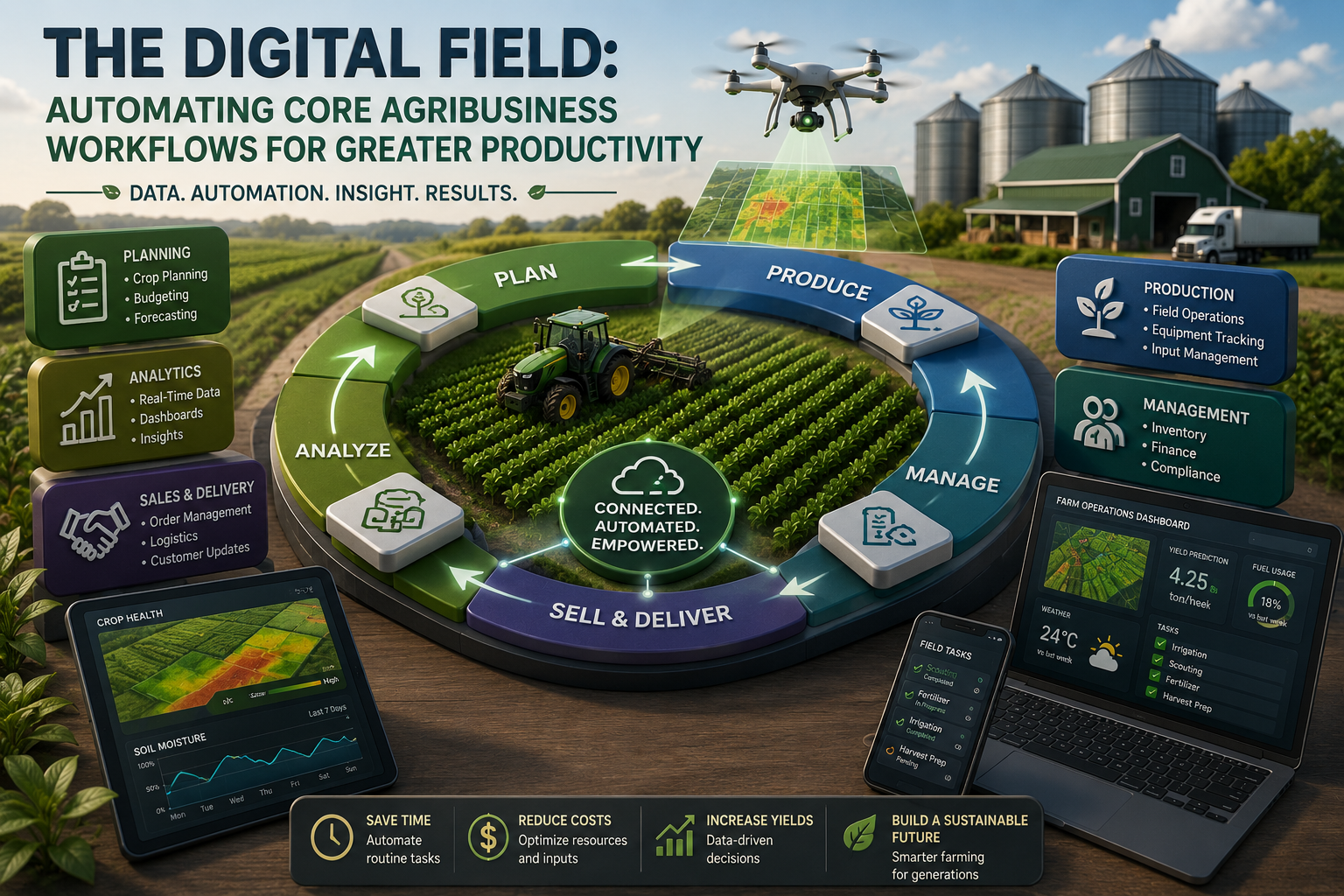
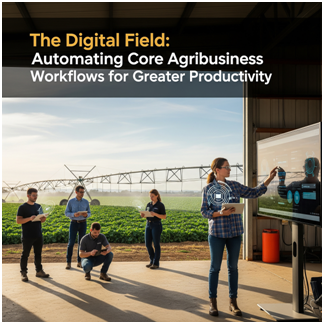
The “Digital Field” represents a significant shift in agribusiness, moving from traditional, often manual, operations to a more automated and data-driven approach.1 This transformation promises greater productivity, efficiency, and profitability for agribusinesses of all sizes.2 By automating core workflows, businesses can streamline operations, reduce errors, and gain real-time insights into their processes.3

Here are specific examples of manual processes within agribusiness that can be automated, along with their immediate benefits:
1. Inventory Tracking and Management

Manual Process:

  • Manually counting stock (seeds, fertilizers, chemicals, equipment parts) in warehouses or storage facilities.
  • Updating spreadsheets or physical ledgers to reflect inventory changes.
  • Estimating stock levels for reordering, often leading to overstocking or stockouts.
  • Manual reconciliation of inventory with sales and procurement records.

Automated Solution:

  • Sensors and IoT devices: Automated tracking of inventory levels in bins, silos, and storage units using weight sensors, RFID tags, or barcode scanners.4
  • Integrated Inventory Management Systems (IMS): Software that automatically updates inventory levels upon sales, deliveries, and transfers.5
  • Predictive Analytics: AI-powered systems that analyze historical data and market trends to forecast demand and optimize reorder points.6

Immediate Benefits:

  • Reduced Stockouts and Overstocking: Real-time visibility ensures optimal inventory levels, minimizing losses from expired products or missed sales opportunities.7
  • Improved Accuracy: Eliminates human error in counting and recording, leading to more reliable inventory data.8
  • Faster Turnaround Times: Automated processes for receiving and dispatching goods, reducing waiting times.
  • Optimized Storage Space: Better inventory management allows for more efficient use of warehouse space.9
  • Enhanced Reporting: Instant generation of inventory reports, aiding in quicker decision-making.

2. Order Processing and Fulfillment

Manual Process:

  • Taking orders over the phone, via email, or in person, then manually transcribing them.
  • Manually checking product availability and pricing.
  • Creating paper invoices and delivery notes.
  • Manual scheduling of deliveries and dispatching.
  • Discrepancies arising from human error in order entry or calculation.

Automated Solution:

  • E-commerce Platforms/Online Portals: Customers can place orders directly, with real-time updates on product availability and pricing.10
  • Enterprise Resource Planning (ERP) Systems: Integration of order entry with inventory, pricing, and customer relationship management (CRM) modules.11
  • Automated Invoicing and Payment Processing: Digital generation of invoices and integration with payment gateways.12
  • Route Optimization Software: Automated planning of delivery routes based on order locations and vehicle capacity.13
  • Automated Picking and Packing: Use of robotics or automated systems in warehouses for fulfilling orders.

Immediate Benefits:

  • Faster Order Cycles: Significantly reduces the time from order placement to delivery.
  • Reduced Errors: Eliminates manual data entry errors, ensuring accurate orders and invoices.14
  • Improved Customer Satisfaction: Quicker service and accurate order fulfillment lead to happier customers.15
  • Increased Efficiency: Frees up staff from administrative tasks to focus on higher-value activities.16
  • Better Cash Flow: Faster invoicing and payment processing improve cash flow.17

3. Field Operations Data Capture and Analysis

Manual Process:

  • Farmers manually recording field observations (e.g., pest sightings, crop health, weather conditions) in notebooks.
  • Surveying fields manually for soil samples or yield estimates.
  • Physically walking fields to assess irrigation needs or equipment performance.
  • Manually transferring data from field notes to computer systems, often with delays and potential for misinterpretation.
  • Lack of real-time insights for immediate decision-making.

Automated Solution:

  • Drones and Satellite Imagery: Automated capture of high-resolution images for crop health monitoring, pest detection, and yield estimation.18
  • IoT Sensors: Deployment of soil moisture sensors, weather stations, and nutrient sensors for real-time data collection.19
  • GPS-Enabled Equipment: Automated tracking of machinery (tractors, harvesters) for precise application of inputs and yield mapping.20
  • Mobile Apps for Field Data Entry: Farmers can directly input observations into a standardized digital format.21
  • Farm Management Software (FMS): Centralized platforms for aggregating, analyzing, and visualizing field data, often with AI-powered analytics.22

Immediate Benefits:

  • Precision Agriculture: Enables targeted application of water, fertilizers, and pesticides, reducing waste and environmental impact.23
  • Early Problem Detection: Real-time data allows for immediate identification of issues like disease outbreaks or equipment malfunctions.
  • Optimized Resource Allocation: Data-driven decisions on planting, irrigation, and harvesting maximize resource efficiency.24
  • Improved Yields: Better understanding of field conditions leads to optimized practices and higher yields.25
  • Reduced Labor Costs: Automating data collection reduces the need for extensive manual surveying.26
  • Enhanced Traceability: Detailed records of field operations improve traceability for compliance and quality control.27

By embracing these automated solutions, agribusinesses can move beyond the limitations of manual processes, unlocking a new era of productivity, sustainability, and profitability in the digital field.

Popular Posts

Supply Chain’s Secret Sauce: How Workflow Tools Bolster Resiliency and Visibility

January 8, 2026

From Seed to Sale: Connecting the Dots for Competitive Advantage through Integrated Data

January 8, 2026

Beyond the Ledger: Why Integrated Accounting, CRM & ERP are Non-Negotiable for Modern Agribusiness

January 7, 2026
Core Agribusiness Workflows

The Digital Field: Automating Core Agribusiness Workflows for Greater Productivity

January 7, 2026
Quality Control as a Revenue Driver

Quality Control as a Revenue Driver: Automating Deviation Management Workflows

December 22, 2025

Book Your Initial Consultation

BOOK NOW
Chat with us

    Hi! Have a question? We're here to help.