


Artificial intelligence is rapidly changing the way businesses interact with their information. With the release of Acumatica 2026 R2, that transformation has taken an important step forward.
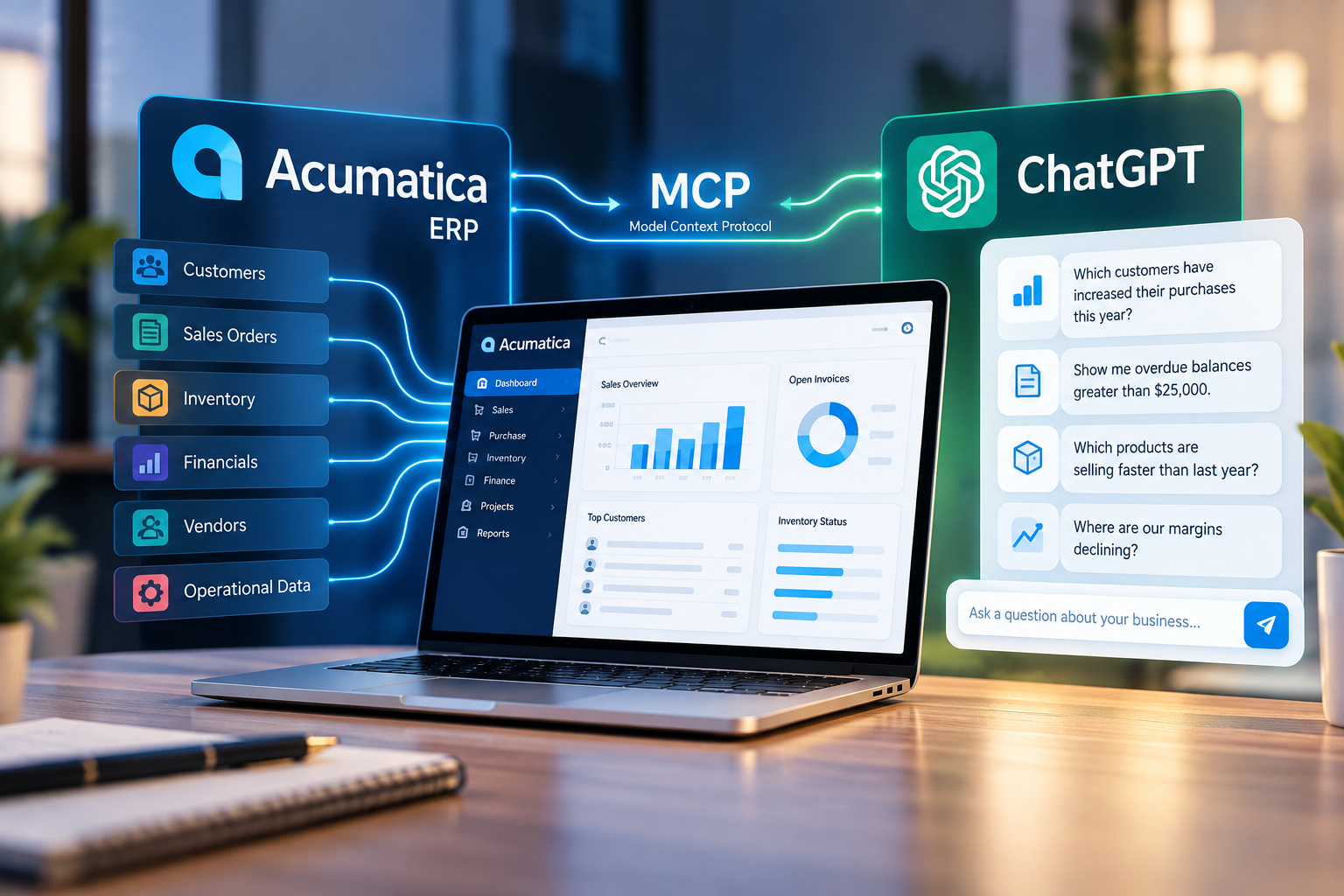
Acumatica has introduced support for Model Context Protocol (MCP), allowing organizations to securely connect external AI tools such as ChatGPT to approved Acumatica ERP data.
What does that mean for your business?
In simple terms, it means you can begin using conversational AI to ask questions about your business using information stored in Acumatica—without repeatedly exporting reports, creating spreadsheets, or manually uploading ERP data into an AI application.
MCP stands for Model Context Protocol. It is a standard that allows AI applications to connect with external systems and approved sources of information.
Think of MCP as a controlled bridge between Acumatica and an AI assistant.
Traditionally, if you wanted ChatGPT to analyze information from your ERP system, you might first run a report, export the information to Excel or CSV, and then provide that information to the AI application.
With Acumatica’s MCP connection, an authorized AI application can instead access approved information directly from Acumatica.
The result could be a fundamentally different way of interacting with ERP information.
Instead of asking:
“Which report should I run?”
a manager can increasingly ask:
“Which customers have significantly increased their purchases this year?”
or:
“Show me customers with overdue balances greater than $25,000.”
The objective is to make interacting with business information more conversational and intuitive.
One of the most important aspects of this technology is that ChatGPT does not replace Acumatica.
Acumatica remains your ERP system and system of record.
Your customers, vendors, inventory, invoices, orders, financial transactions and operational information continue to reside within Acumatica.
The AI application provides another way to interact with authorized portions of that information.
For the initial MCP capabilities in Acumatica 2026 R2, administrators can provide external AI applications with governed, read-only access to information made available through Generic Inquiries.
That distinction is important.
It means an organization can determine what information is exposed rather than simply providing an AI application unrestricted access to the entire ERP database.
The possibilities will depend on the Generic Inquiries and information your organization makes available.
For example, imagine asking questions such as:
“Who are our 20 largest customers this year?”
“Which customers have decreased their purchases by more than 20%?”
“What products are generating the greatest sales growth?”
“Which customers owe us more than $10,000 and are more than 60 days past due?”
“Show me our largest overdue invoices.”
“Which customers consistently pay late?”
“Which products are selling faster than they did last year?”
“Which inventory items haven’t sold in six months?”
“Where do we appear to have excess inventory?”
“Which vendors have increased their prices the most?”
“What products are taking longer to receive than they did last year?”
“What changed most significantly in the business this month?”
“Where are our margins declining?”
“Which areas should management investigate?”
These examples illustrate the larger opportunity: turning ERP information into a conversation instead of requiring users to know exactly which report, inquiry or screen contains the answer.
Connecting an AI application to ERP data naturally raises an important question:
Who can see what?
Acumatica has designed its MCP implementation around its existing security model. According to Acumatica, role-based permissions, inherited security and field-level data masking can carry over when information is accessed through MCP.
That is significant because AI shouldn’t become a way to bypass ERP security.
For example, a salesperson should not suddenly be able to ask an AI assistant for confidential payroll information simply because the company enabled an AI connection.
Organizations still need to carefully design and review the information they make available to AI, but Acumatica’s approach provides administrators with governance over that access.
Acumatica is pursuing AI from more than one direction.
Acumatica AI Assistant provides a conversational AI experience from within Acumatica. Users can ask questions in natural language, explore authorized ERP information, drill into underlying records and create tables, charts, pivot-style results and dashboard widgets.
MCP, on the other hand, creates a connection that allows compatible external AI applications—including ChatGPT—to interact with approved Acumatica information.
This distinction is important.
A company may have employees who spend much of their day inside Acumatica and prefer the integrated AI Assistant.
Executives and other employees may already use ChatGPT as part of their normal workflow.
MCP begins to provide a bridge between those environments.
ERP systems have traditionally required users to adapt themselves to the software.
A user needs to know which screen to open, which report to run, which filters to select and sometimes how the underlying data is structured.
Generative AI begins to reverse that relationship.
Instead of learning how to find the data, users increasingly can describe what they want to know.
Consider an executive preparing for a management meeting.
Rather than requesting several reports from accounting, sales and operations, that executive could eventually have a conversation with an AI assistant:
“How are sales performing compared with last year?”
Then:
“Which customers account for most of the increase?”
Then:
“Are margins improving for those customers?”
Then:
“Are any of those customers significantly past due?”
That conversational progression is potentially much more powerful than simply generating another static report.
There is an important catch.
Connecting AI to an ERP system does not automatically make a business intelligent.
If customer records are inconsistent, inventory information is inaccurate, processes aren’t standardized or important information lives outside the ERP system in disconnected spreadsheets, AI may simply expose those problems more quickly.
This is why business process review becomes even more important in the age of AI.
Before asking, “How can we add AI?”, organizations should ask:
These questions help identify where AI can create measurable business value rather than simply becoming another technology experiment.
Conversational access to information is only part of Acumatica’s AI strategy.
Acumatica 2026 R2 also expands AI Assistant, AI Automation and AI Anomaly Detection.
This points toward a progression from asking AI questions to having AI help identify exceptions and automate appropriate business processes.
Imagine the difference between:
“Show me customers who are significantly overdue.”
and a system that proactively identifies unusual changes in customer payment behavior and brings them to someone’s attention.
Or moving from:
“Which products have unusually low margins?”
to automatically identify margin exceptions that require management review.
This evolution—from finding information to identifying exceptions and assisting with workflows—may ultimately have an even greater impact on productivity than conversational reporting itself.
Businesses using Acumatica don’t need to automate everything at once.
A better approach is to identify several high-value use cases.
Start with questions your employees repeatedly spend time answering.
Look for reports that require manual manipulation.
Identify processes involving repetitive data entry or analysis.
Determine which business decisions are delayed because employees can’t easily get the information they need.
Then evaluate whether Acumatica’s AI capabilities—including AI Assistant, AI Automation, Anomaly Detection and MCP connectivity—can improve those processes.
The objective shouldn’t simply be “implement AI.”
The objective should be to identify places where AI can help employees work faster, make better decisions and eliminate unnecessary manual effort.
For decades, ERP has primarily been the place where businesses record what happened.
Orders were entered. Invoices were generated. Inventory was received. Payments were recorded. Financial statements were produced.
AI creates the opportunity for ERP to become something more.
It can help businesses understand what is happening, why it is happening, what deserves attention and what action should be considered next.
Acumatica’s new MCP connection is an important step in that direction because it allows organizations to combine the structured operational information contained within their ERP system with the conversational capabilities of modern AI applications such as ChatGPT.
For businesses already using Acumatica—or evaluating their future ERP strategy—the question is quickly changing from:
“Should we use AI?”
to:
“Where can AI create the greatest measurable improvement in our business?”
Is Your Business Ready for Acumatica + AI?
CRM Systems, Inc. helps organizations evaluate their CRM and ERP processes and identify opportunities to improve automation, reporting, data visibility and operational efficiency.
Our Business Process Review can help identify where Acumatica and AI can deliver practical value across sales, accounting, inventory, purchasing, operations and management reporting.
Schedule a complimentary 30-minute consultation with CRM Systems to explore how Acumatica + AI could improve the way your business operates.
Acumatica 2026 R2 Is Here: What’s New?

Sage CRM + Sage ERP Integration: Connecting Sales With the Rest of Your Business
Acumatica + ChatGPT: What the New MCP Connection Means for Your Business
How a Sage CRM System Can Help You Manage Your Accounting Data More Effectively
Sage CRM Solutions: How to Reduce Implementation Costs Without Compromising Results